
By Jadyn-Kathleen Polk
Whether or not human impacts on the climate are important is one of the most politically controversial topics today. To believe or not to believe will determine what the next several decades of public policy look like, and what our world will look like. This intentionally short paper is a resource for those who want a clear understanding of how anyone knows that climate change exists and what makes it so important.
By the end of this paper, you will have the information to discern for yourself what climate change is and what to make of it. To do this, we will explore both natural and human actions that make up climate change as we know it today. Hopefully, then, you can decide once and for all how much you care.
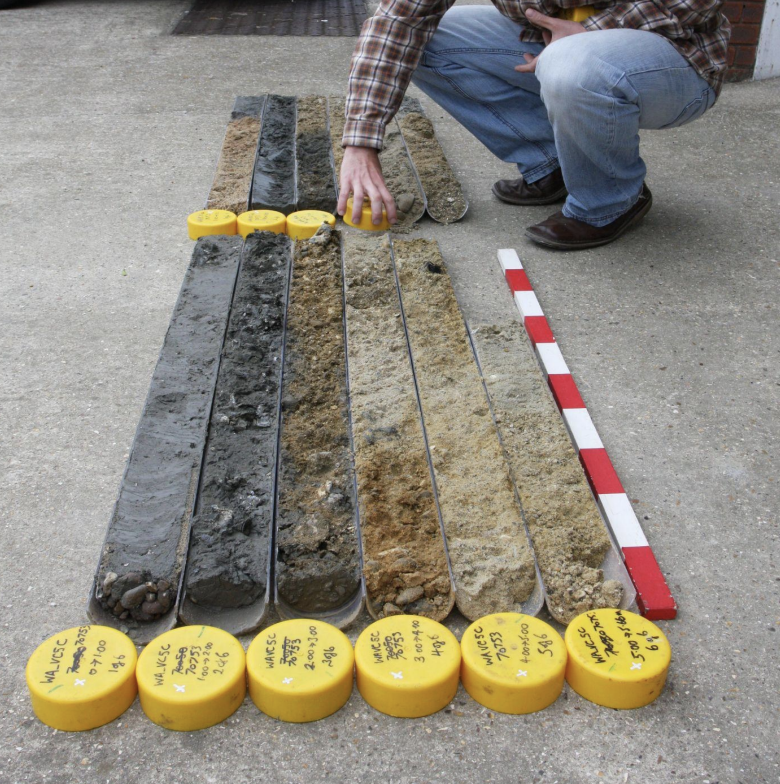
Smithsonian. Wessex Archaeology. “Complete Seabed Cores.” 2010. Flikr.
Records of past climates have been preserved in natural ways that store our Earth's history of change for us to decode and learn from centuries later. Like any record, studying its patterns helps us know what to expect in the future and reveals cycles. The oldest records we have can be found in ocean sediments that are extracted from the ocean floor, and according to the Smithsonian, those records can go back 65 million years into Earth's past.
Over time, as sediment sinks to the ocean floor, it forms layers of buildup. The layers of sediment hold information about who was there and what was happening at the time that the sediment settled on the ocean floor. For example, the oxygen trapped inside of old dead plankton reveals what temperature it was at the time that the plankton died. All of the things that plankton are and become is truly magical, but I digress 1. Other preservation processes can be found in ice cores, dendrochronology (tree rings), and deep-sea corals.
With the help of these natural preservation processes, we have learned that there is a natural pattern of the Earth becoming very hot and then very cold. One contributing factor is the proximity of our Earth to the Sun at different times; these factors are known as Milankovitch Cycles. Some other factors include volcanic eruptions that block sunlight or tectonic plate movements that change where albedo occurs. Albedo is how much a surface reflects light and absorbs heat. For example, white ice reflects heat, keeping glacial areas cold, whereas the dark bark of a tree absorbs heat.2
Our orbit is more of a wobbly, uneven oval rather than a smooth circle, so at certain times we are at the point farthest from the Sun, or at the point closest. Changes in orbit and therefore distance to the Sun, known as the Milankovitch Cycles, produce global heating and cooling conditions. When all of the cycles work together, they create a dramatic climate change, like bringing Ice Ages or creating perfectly warm temperatures for life to begin inside of freshly melted primordial water.
The last Ice Age was about 12,000 years ago, but more frequent changes are recorded, like Pacific Decadal Oscillations that change the Pacific Ocean's climate and biodiversity (or composition of marine life) every 20-30 years.
We are currently in an interglacial period or between glacial periods. Interglacial periods only last around 30,000 years, and we’re 11,700 years into this phase. Glacial periods are onset by a drop in global temperature of 4° to 5° Celsius; that’s it. Just a few degrees goes a long way, whether that be hot or cold 3.
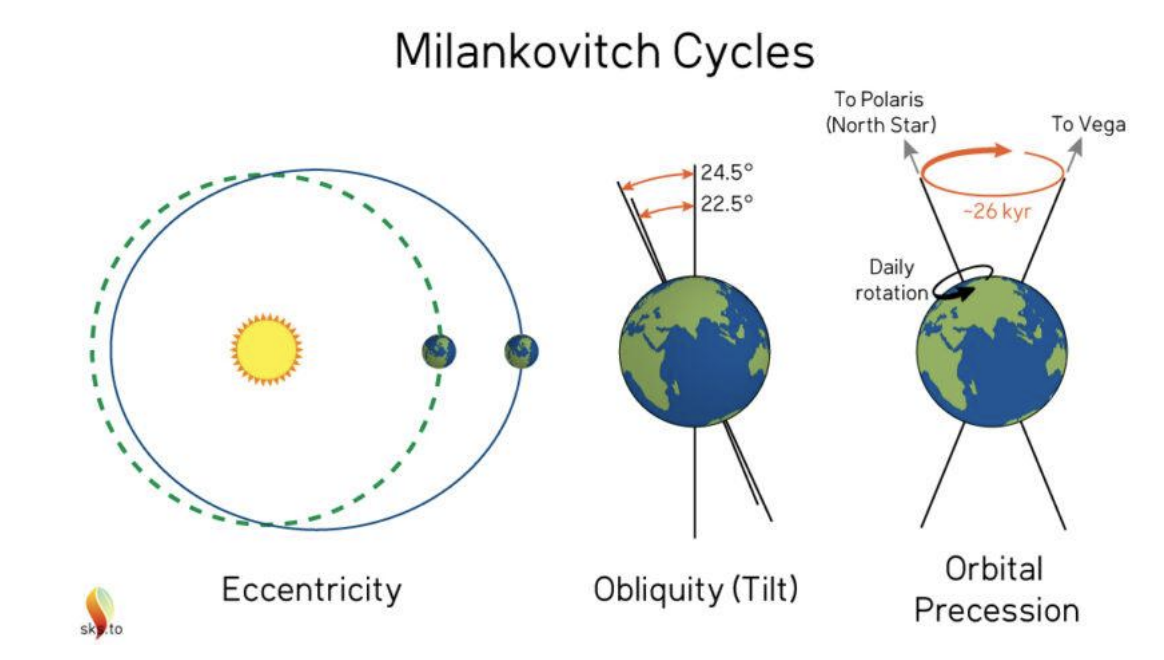
Anna, Joaquimma. “Milankovitch Cycles.” 2025. Platform for Agriculture and Climate Transformation.
Humans contribute to these natural cycles by producing greenhouse gases. Greenhouse gases are so important because they trap heat and radiate it back out into the atmosphere. This is what we want them to do; it’s great that greenhouse gases trap heat! Our natural amount in the atmosphere helps maintain an average global temperature of about 59°F. Without greenhouse gases, the global temperature would be 0°F 4. The problem comes when we create or release excessive amounts of greenhouse gases, which we have been doing for over a century. Burning fossil fuels creates greenhouse gases, while other processes release them.
Fossil fuels are old dead organisms preserved in the floor of watery beds (e.g., oceans, swamps) that have to be extracted by either drilling (e.g., diesel, gasoline, natural gas) or mining (e.g., coal). We like to burn fossil fuels as an energy source to power our vehicles, our lights, and whatnot. Aside from producing greenhouse gases, we also release them.
When we cut down excessive amounts of trees to make room for economic development projects or use fishing methods like seafloor trawling, we release carbon. As a part of their ecosystem contributions, both trees and seafloor sediments store carbon (a greenhouse gas) that would otherwise be in the atmosphere. Destroying and cutting these landscapes releases carbon that was kindly being stored for us.
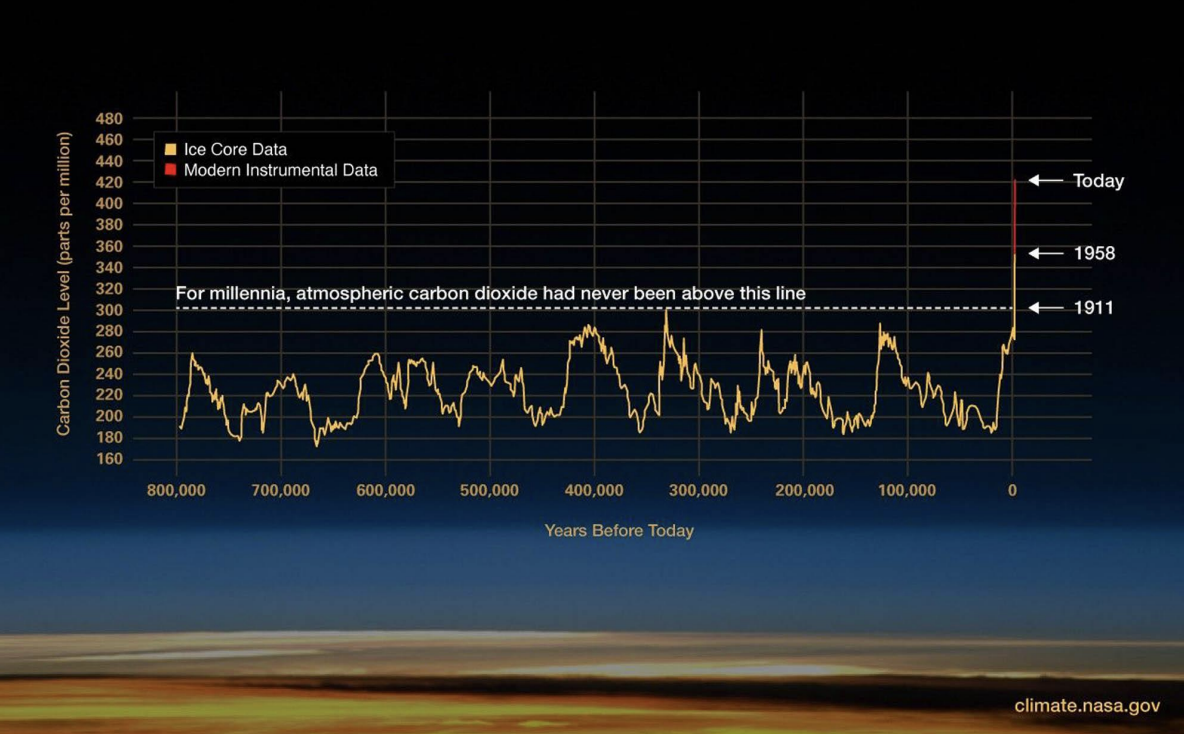
Lüthi, Dieter. “Vostok Ice Core Data.” 2008. NASA.
Scientists started recording our climate patterns in the 19th century and have been able to chronicle the climate 65 million years into our past using ocean sediment! We’ve found that a massive spike in global temperature followed the Industrial Revolution (1760-1840), and has been steadily increasing since then 5. As mentioned before, the Earth has been getting very hot and then very cold on a loop for at least 65 million years. Now, we can compare our current climate to ancient records and observe that the rate we are warming up at is dangerously fast. Sea level rise, weather abnormalities, and the health of marine life that depend on cooler temperatures are consequences that we will need to manage on an increasingly large scale if warming is allowed to continue at this rate.
Earth has natural ways of balancing itself. When humans intercept natural processes, we must be prepared to manage and restore the output or the consequences of our project's results. At least in an ecological sense, we are directly the cause of these new changes.
In conclusion, while climate change is a natural phenomenon, the rate at which we experience these changes is being sped up and exacerbated by human actions through the means of greenhouse gases. Alaska is growing, and New Orleans is sinking. Fish are being born with growth defects, and the Earth is getting warmer. Our climate is changing. Yet, our government moves to resume oil drilling on our coasts, and technology like wind farms is not being invested in. Do you think human-induced climate change is important enough to invest in preventing further warming? What would you do if you were president?
Citations: Gaus, Annie. 2026. “President Trump orders drilling to resume off California.” The New York Post. (President Donald Trump orders oil drilling in California).Smithsonian: National Museum of Natural History. 2010. “Sediment Cores.” Smithsonian: National Museum of Natural History. 2010.(Sediment Cores | Smithsonian Ocean).NASA Science Editorial Team. 2020. “Milankovitch (Orbital) Cycles and Their Role in Earth’s Climate.” NASA Science. (Milankovitch (Orbital) Cycles and Their Role in Earth's Climate - NASA Science).NASA Science. 2024. “Evidence - The rate of change since the mid-20th century is unprecedented over millennia.” NASA Science.(https://science.nasa.gov/climate -change/evidence/ ).Ritter, Michael E. 2012. “Glaciation.” The Physical Environment. (Glaciation ).Earle, Steven. 2021. “3.2 Plate Tectonics and Climate Change.” Environmental Geology. (3.2 Plate Tectonics and Climate Change – Environmental Geology).Science Insight. 2026. “What the Earth’s Atmosphere Is Made Of and How It Works.” Science Insights. (What the Earth’s Atmosphere Is Made Of and How It Works - ScienceInsights).Gale, Jen. 2025. “What triggers an ice age?” The Instutute for Environmental Research and Education. (What triggers an ice age? - The Institute for Environmental Research and Education).Lev, Sophie. 2020. “Santa Cruz/ Westlake Springs History.” Kids in Nature Teacher Training Handbook.IERE Team. 2025. “What is the surface temperature of Earth?” The Instutute for Environmental Research and Education. (What is the surface temperature of Earth? - The Institute for Environmental Research and Education).Cruse, Anna M. 2019. “Sea Sediments and Climate Change.” EBSCO. (Sea sediments and climate change | Oceanography | Research Starters | EBSCO Research ).
Meet the Author
Jadyn-Kathleen Polk
Student at University of California, Santa Cruz and 2026 MIA Summer Intern
