By Katherine Solomon
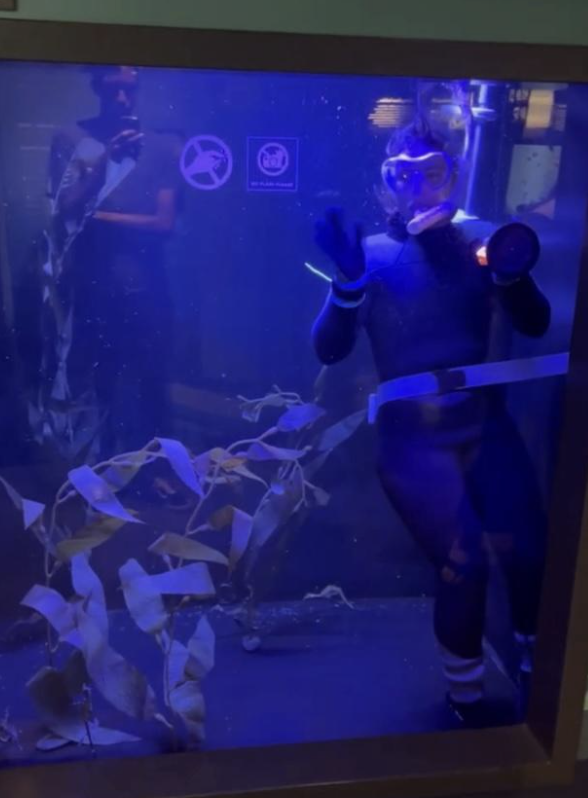
Photo taken by DeAndre Daniels: Kate waving from inside the adult sea dragon tank
I always loved travelling and exploring beaches, so when I decided to go to college and major in Marine Biology, I didn’t know that it would take me to Hawaiʻi for almost a year. I wanted to study away from the Northeast where I lived my whole life.
In my junior year I participated in an exchange program and became a student at The University of Hawaiʻi at Mānoa (UHM) for nine months. Of course, Hawaiʻi is gorgeous and most people go to relax on a beach or do crazy hikes. While I still did both of those activities, I had a slightly different, more scientific experience.
As an aspiring scientist, I wanted to go somewhere I had never been to further improve my education of the ocean through different experiences. To achieve this, I took eight amazing classes while at UHM, and started volunteering at the nearby university-partnered Waikīkī Aquarium as a Monk Seal Educator. I would educate visitors on the marine mammal living at the aquarium and wanted to do something more with that role.
I decided to continue my exchange for a second semester in the spring, and applied for one of the internships the aquarium was offering, which was a Syngnathid Aquarist position. I was offered the role and happily accepted!
Stepping Behind the Glass
What interested me most about working at the aquarium was getting hands-on experience in the world of animal care, husbandry, and educating people on why protecting the ocean is so crucial.
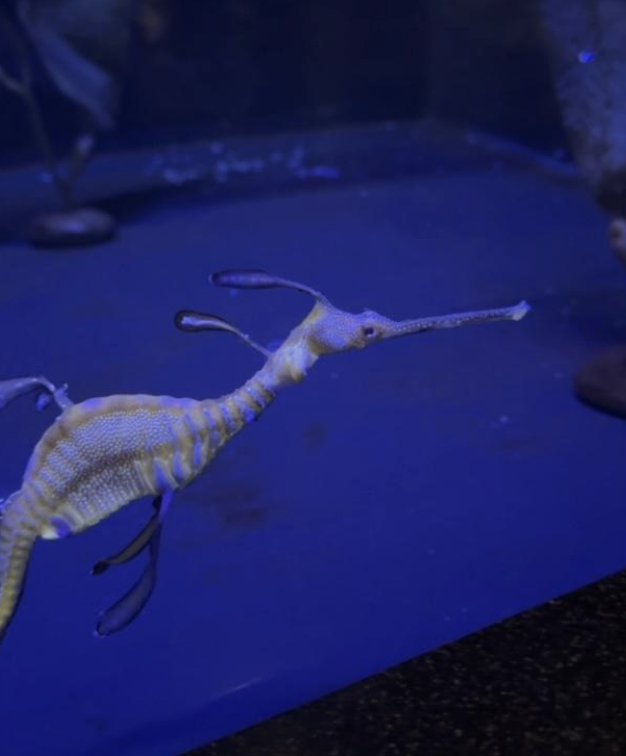
Photo taken by Kate Solomon: adult sea dragon named Two, identified by her yellow coloring
The aquarium has over 490 species, but I only worked with a handful of them. Mainly, I worked with the fish in the Family Syngnathidae, or syngnathids. Members of the family I cared for were: baby, juvenile, and adult lined seahorses, common seahorses, juvenile and adult weedy sea dragons, dragonface pipefish, and banded pipefish.
Our common seahorse named Ziggy was special because he was found washed ashore on the North shore of Oʻahu and was rescued by the aquarium. Seahorses usually do not survive when stuck on land because they cannot survive outside of their environment, but also are not physically able to get their bodies back in the ocean. He was our “resident local” since the other syngnathids species we take care of such as the weedy sea dragons, are not native to the Hawaiian Islands.
Our Local Hammah Ziggy
One day I came in and Ziggy had a bubble on his head and inside his belly, also known as gas bubble disease. I was shown how to suck up that air with a petite syringe, because the bubbles cause buoyancy issues. I held him gently in my hand and felt his strong ribs and his tiny heart beat. I thought he was so cute even though I could feel his fear with his increasing heart beat.
After removing the bubbles, he was all recovered and went quickly back into his tank! This procedure taught me technique on how to handle small animals, since similar procedures were performed on other sick fish.
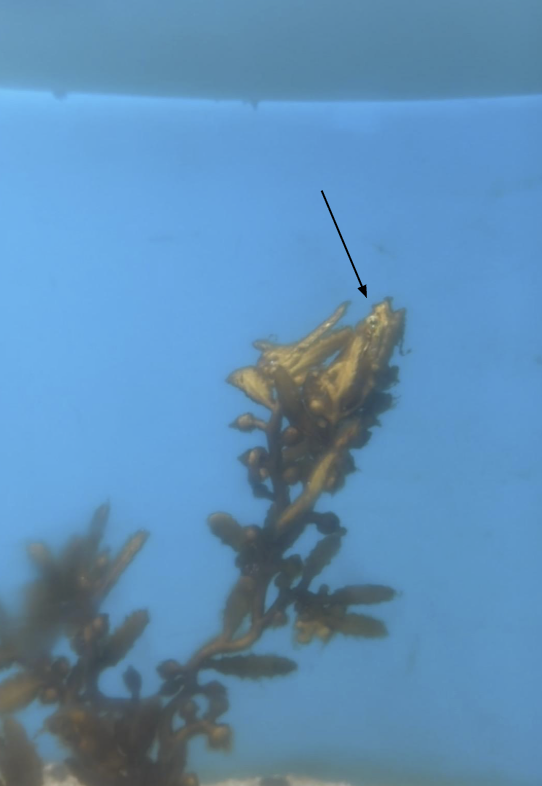
Photo taken by Kate Solomon: Ziggy camouflaging in his seaweed
Occasionally, I worked with quarantined animals, some of which were seahorses and pipefish. The seahorse had popeye, which bulges up the eyeball. He stayed under careful watch until it wore off. We had also received five new pipefish that needed treatments to acclimate them to their new home after getting shipped from another aquarium.
They seemed to be in rough shape when they arrived, so we made a solution with nitrofurazone, an antimicrobial medication, and let them swim in it a couple times a week. Unfortunately the pipefish did not survive. Although it was sad to see them all die, I reminded myself it is a part of life and became a valuable learning experience for me to not only deal with death, but find the cause as well since afterwards we performed a necropsy.
Morning Rounds & Moods
A typical day usually starts for me at 7am, and immediately preparing the different diets for the syngnathids. I first start out by thawing the frozen food while feeding out the live Brine shrimp (Artemia) while the frozen food thaws. Brine shrimp are also known as sea monkeys and are bright orange.
Once I fed out the live food, I would feed the frozen shrimp to its respective tanks, and be mindful not to forget the quarantined fish in the back! Since the brine shrimp are brightly colored, we could regulate how much the seahorses were eating based on how white or orange they were. Syngnathids don’t have stomachs, so they need to be constantly eating. This is part of the reason we monitored the sea dragons, to make sure they ate.
After feeding the adult sea dragons, it was important that we observed their behavior for five to ten minutes. Behaviors we looked out for were details such as who ate (and how much), lying on the floor or rising to the surface, or if any of them were showing mating behaviors.
Mating behaviors were usually seen between the same two dragons most days. When sea dragons mate it starts by them swimming near each other while curling their tails, then “nudging” the other with their snout. They would do this almost everyday during my entire time there.
Although it never progressed past the nudging stage, it was super amazing to see the males hold the eggs on the underside of their tail. This is a characteristic of all syngnathids, that the males carry the babies until birth. Nonetheless, we would record all of this data online on Tracks software. It was always special to see this occur, and know that the dragons felt comfortable and safe enough to act this out. Sea dragons have historically been treated very delicately in aquariums, so we wanted to make sure they were all behaving normally and happily.
Adult seahorses do occasionally eat their babies and so did the corals in the tank. So if any were born, I would quickly scoop them out to transfer to the baby tank.
One of my favorite things about working with syngnathids was that there were seahorse babies born almost every week. Lined seahorses are interesting because the males develop the eggs into babies in their brooding pouch for twenty one days, then give birth. After giving birth they can get pregnant four days later.
By the end of my ten weeks interning with the syngnathids, we had to fully separate the males from the females because there were too many babies being born. Because of this, we sent multiple babies to other aquariums we partnered with.
Like most other males in the animal kingdom, seahorses have to attract the females and work for the mating process. When I first started, there were two adult seahorse tanks, one tank had males and females together, and the other had only males. At one point, the tank with only males looked like the males were pregnant, but we knew that there was no way they were actually pregnant because seahorse sex is relatively easy to tell apart by their body shapes.
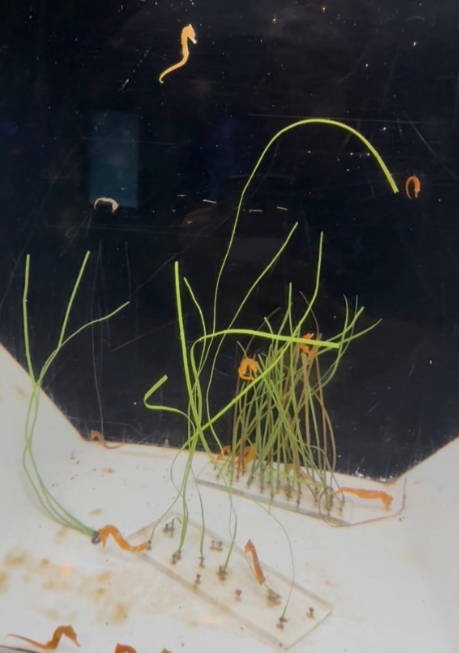
Photo taken by Kate Solomon: juvenile lined seahorses
We soon learned that all the males could actually see the females through the glass next to them and filled their brooding pouches with water to attract females by showing them how many babies they could hold. It is equivalent to fish making sand art or peacocks displaying their intricate feathers. I thought this was so interesting and aquarium visitors always liked this phenomenon as well.
It was always fun whenever people would come up to the seahorses and ask about the males being the ones that get pregnant, or find out if they didn’t know. The wife in a couple would always have something funny to say to her husband. Without fail, that always got the feminists going!
The Rhythm of Routine
Some things that people might not know about aquarium operations are that they contain super repetitive tasks and are physically demanding! Everyday, multiple times a day, we have to stand and lean over tanks. The animal husbandry tasks would consist mostly of cleaning tanks, and each tank had its own process.
All of them would get window wipes on a large and small scale. Some tanks received gravel washes or siphons to get waste, food, or bacteria out. The salinity of the water in a few tanks had started to become slightly off, so after siphoning I would add a few gallons of reverse osmosis water to get the salinity back to normal.
The last steps of cleaning would be rinsing and changing out the filter bags. These would filter the food going into the tanks and would usually be much dirtier in the tanks with frozen food. There was a similar process with the protein skimmers, which extract waste, food, and oils so they don’t degrade in the water.
Like any job, I faced some challenges, though not drastic. Working in all weather conditions definitely could be tough sometimes. Most of the maintenance and cleaning was done outside, so when it rained (and it rains a ton in Honolulu), I got soaked. One time the power went out for a split second, so we had to check all of the tanks for any issues, making sure chillers were keeping temperatures regulated, no air bubbles were forming, and that the animals all seemed content.
For the adult sea dragons, once a week I would suit up in a 5mm wetsuit and a snorkel and dive in the sixty degree water to wipe the walls with a sponge and scrub brush. This was one of my favorite tasks, despite the cold and needing to be mindful of my body and where the six dragons were, but I thought it was super cool to be in the tank with the cuties and wave to visitors from the other side of the glass. One of the last tasks of my internship was introducing small sea urchins to the seahorse tanks to help combat the algae growth.
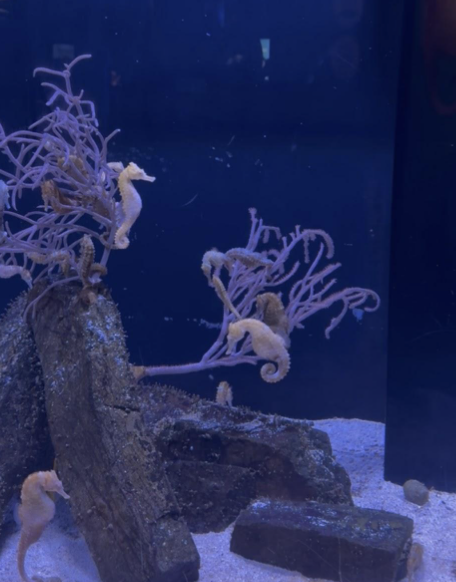
Photo taken by Kate Solomon: Adult lined seahorses hanging on a purple sea whip
Sea-ing My Future
From this experience I definitely gained many skills. I learned how to operate and maintain a fish tank and what abnormalities to look for, certain behaviors to monitor in different species, how to convey scientific information to people of different ages and education levels, and how to compose myself and others in stressful situations.
The experience changed my views on aquarium animal care and husbandry because although every aquarium is different, everyone there genuinely cared about the animals and wanted the best for them. No animal was neglected. There was a whole room in the back for just quarantined animals that needed some extra love.
I’m extremely grateful for my entire exchange experience in Hawaiʻi, from learning a new culture to living in a new environment, but being able to participate in the responsibilities of caring for these delicate fish opened a new door for me. It changed my perspective on what I’d like to do with my degree and provided me with a network of people I’ll never forget. Mahalo nui to everyone at the Waikīkī Aquarium, I will never forget my time there.
Keep up with the aquarium! Check out their work at https://www.waikikiaquarium.org/ or follow their Instagram @waikikiaquarium.
Meet the Author
Katherine Solomon
B.S. from University of Rhode Island and 2026 MIA Summer Intern
