By Araceli Hernandez
We all know and love shellfish like crabs and oysters as popular seafood choices for dinner, but have you heard about Abalone? Abalone are large gastropod mollusks that inhabit coastal waters along the West Coast of North America, New Zealand, South Africa, Australia and Japan. About 56 species of these marine snails have been identified in the world, with 7 species inhabiting the coastline of California. These seven species include white abalone, black abalone, red abalone, green abalone, pink abalone, pinto abalone and flat abalone. The range of the various Abalone species depends on seawater temperatures hence why it is a rare desirable delicacy.
Where are Abalone Now?
Abalone was once a thriving commercial and recreational fishery, but fisheries began closing in 1996 due to abalone population drops and a final closure occurring in 2018. All seven local California species are considered to be endangered by the IUCN(International Union for Conservation of Nature). The White Abalone and Black Abalone are additionally considered endangered at the federal level as well, and White abalone specifically have had a decrease in their populations by over 99% and have come close to extinction. This is a result of overfishing along with other factors such as climate change and withering foot syndrome (A bacterial disease that attacks the digestive tract of an abalone. To prevent starvation, the infected abalone shrinks their foot making it unable to attach to rocks and becoming more susceptible to predation and death.)that also negatively affect their populations. Now why is it important to conserve these populations of Abalone? In their environments, abalone act as kelp architects, grazing on kelp which ultimately leads to more open space for multiple kelp species to grow. By aiding in kelp diversity, this helps with the diversity of fish and other animals in these environments. Unlike sea urchins who can eat through the whole root system of kelp forests, abalone only graze on the blades of drift kelp, therefore allowing kelp to regrow easily. Before Abalone fisheries closed completely, this market brought in millions of dollars for West Coast economies and if these populations recover, the economic role that these abalone play in our society can be restored as well. The once abundant abalone were also culturally significant in Indigenous people’s lives and were used in a variety of ways such as food source, spiritual regalia, and trade. The native Indigenous group in the Santa Barbara area is the Chumash people. The abalone served as a culturally significant species that provided nutrition, and beautiful shells that would be crafted into regalia, fish hooks, and more.
So we know we need to help restore abalone populations, but how can we do so efficiently? The answer is as simple as aquaculture! Aquaculture farms are very common for many shellfish so why not also help support abalone farms as well.
My Role as an MIA Intern
As part of the 2026 Internship Cohort for Minorities in Aquaculture, I have had the pleasure of interning at The Cultured Abalone Farm in Santa Barbara, California for the entirety of the summer.
The Cultured Abalone Farm is one of only two Abalone Farms in California and only one of three in the whole US. Established in 1989 on Rancho Dos Pueblos along the Gaviota coast of Santa Barbara County, TCAF works with three species of abalone(green, white and red) along with two different kinds of red algae, Devaleraea mollis and Gracilaria papenfussii, and purple sea urchins. This facility runs purely on raw sea water meaning that unfiltered sea water comes through with only a large cage around the input pipe preventing bigger animals from coming through, but allowing smaller animals that also start their life as plankton to settle in the tanks as well. The water is pulled in from 40 feet under the surface for two reasons. 1) This depth is naturally where the abalone usually live in the wild so this is a safe temperature for the tanks and 2) This depth creates a natural pressure gradient that helps move the water into the head tanks. From the head tanks, the tallest point of the farm, the sea water is then gravity fed to all tanks.
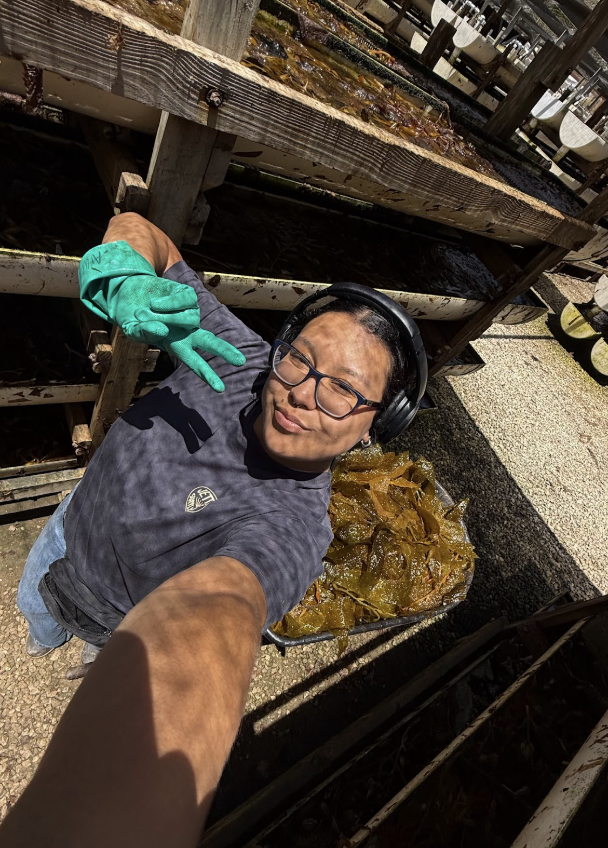
A photo of me doing one of the many tasks I had as an MIA intern. Here I have a wheel barrel full of Giant Kelp, Macrocystis pyrifera, that I fed to the racks of abalone pictured behind me.
Something that The Cultured Abalone Farm focuses greatly on is sustainability. Kelp forests are very significant key environments for the biodiversity of animals. Through sustainable kelp harvest not only are we able to feed our whole farm of abalone, but also ensure that our kelp forests are healthy and thriving. Additionally, culturing red seaweed, such as Dulse and Ogo, allow for another supply of sustainable feed for the animals. It is an important goal of TCAF to ensure we are able to sustainably grow our abalone for restoration efforts and also as a sustainable seafood source.
Fun fact: There are more white abalone in The Cultured Abalone Farm’s hatchery than there is in the wild! This demonstrates how depleted the White Abalone populations are in the wild and therefore how important TCAF’s conservation efforts are.
The Cultured Abalone Farm’s Restoration Efforts
Through aquaculture, and working alongside other environmental groups, TCAF is working towards restoring the populations of abalone we once had in the wild. A few months ago, The Cultured Abalone Farm along with the Bay Foundation were able to outplant about 5,000 red abalone along the Santa Barbara coast. Data collection is utilized to observe how efficient these efforts have been and also used to help build another outplanting plan.
The white abalone restoration project at TCAF is relatively new and still has a long way to go. The oldest white abalone on the facility is about one to 1.5 years old, but fortunately there are multiple white abalone cohorts in the TCAF hatchery that are just starting their journey on the farm. Within the first 3 months abalone are hard to see with the naked eye and are therefore fed microalgae that can settle in their tanks. Between three to six months, they continue to feed on microalgae, but are slowly introduced to macroalgae.
One of my duties on the farm is to help feed giant kelp and red seaweed to our intermediate abalone and older abalone. I was fortunate enough to also be able to feed some of the white abalone in the hatchery their first macroalgae meal of the red seaweed, dulse. I put small amounts of the dulse on the tiles inside their tanks, checked back in a day later, and saw little tiny red dots munching on the dulse! It was truly a really cool experience to be able to help them hit this next milestone of shifting from micro to macroalgae as their main food source. This will help for a smoother transition into the next step of the cycle where they are transferred into the “intermediates.”
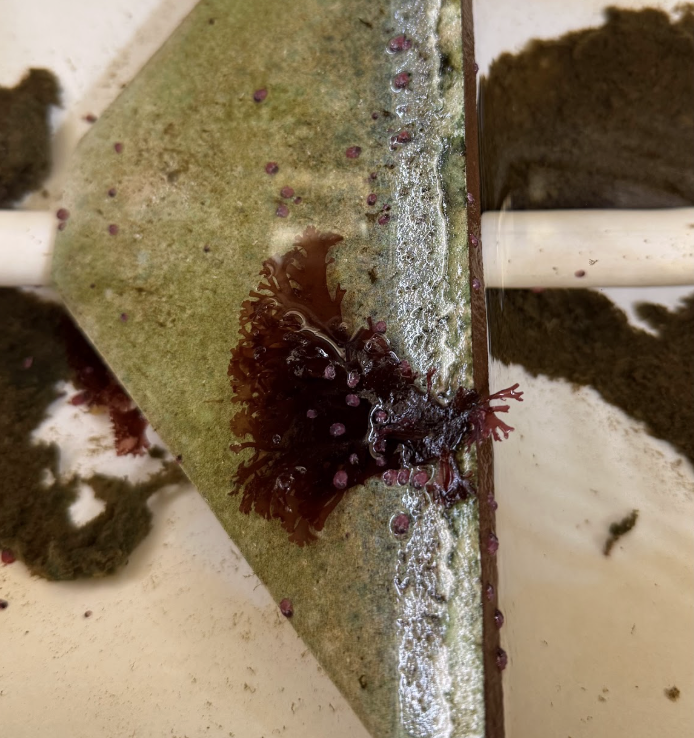
The photo above shows the first macroalgae meal fed to one of the White Abalone cohorts. The macroalgae fed is dulse, Devaleraea mollis. The red dots on the dulse are the early stages of a white abalone.
The “intermediates” is the biggest change that abalone go through during their time at The Cultured Abalone Farm. Since we need to create ideal conditions for the abalone to begin growing in the hatchery, their water is filtered, UV filtered, and also temperature regulated. Once in the “intermediates,” their water is no longer filtered, UV filtered and temperature regulated and are now also exposed to the elements. In the hatchery, each tank can hold hundreds of thousands of abalone, but once moved to the “intermediates” this number greatly decreases. When spawning, abalone focus on quantity over quality hence why it can take long for restoration efforts.
Fun Fact #2: Most abalone grown in California, including the abalone in the Monterey Abalone Company, started at TCAF’s hatchery.
Red Abalone: Restoration and Seafood Option
The most abundant abalone at The Cultured Abalone Farm is the red abalone. The oldest cohorts at TCAF were spawned in 2013, making them 13 years old. Since populations of red abalone are denser in the wild, these animals are able to be consumed and make for a great sustainable seafood option. On the farm, red abalone are harvested as early as three years for the standard size (~¼ lb) and about 10+ years for the Balthazars size. TCAF sells 6 different sizes of abalone making it accessible not just to restaurants, but also home chefs who want to indulge in this rare specialty. As slow growers, abalone require a lot of care and attention to ensure they reach harvest ready sizes. The Cultured Abalone Farm has fully dedicated themselves towards supporting the growth of abalone both for consumption and conservation.
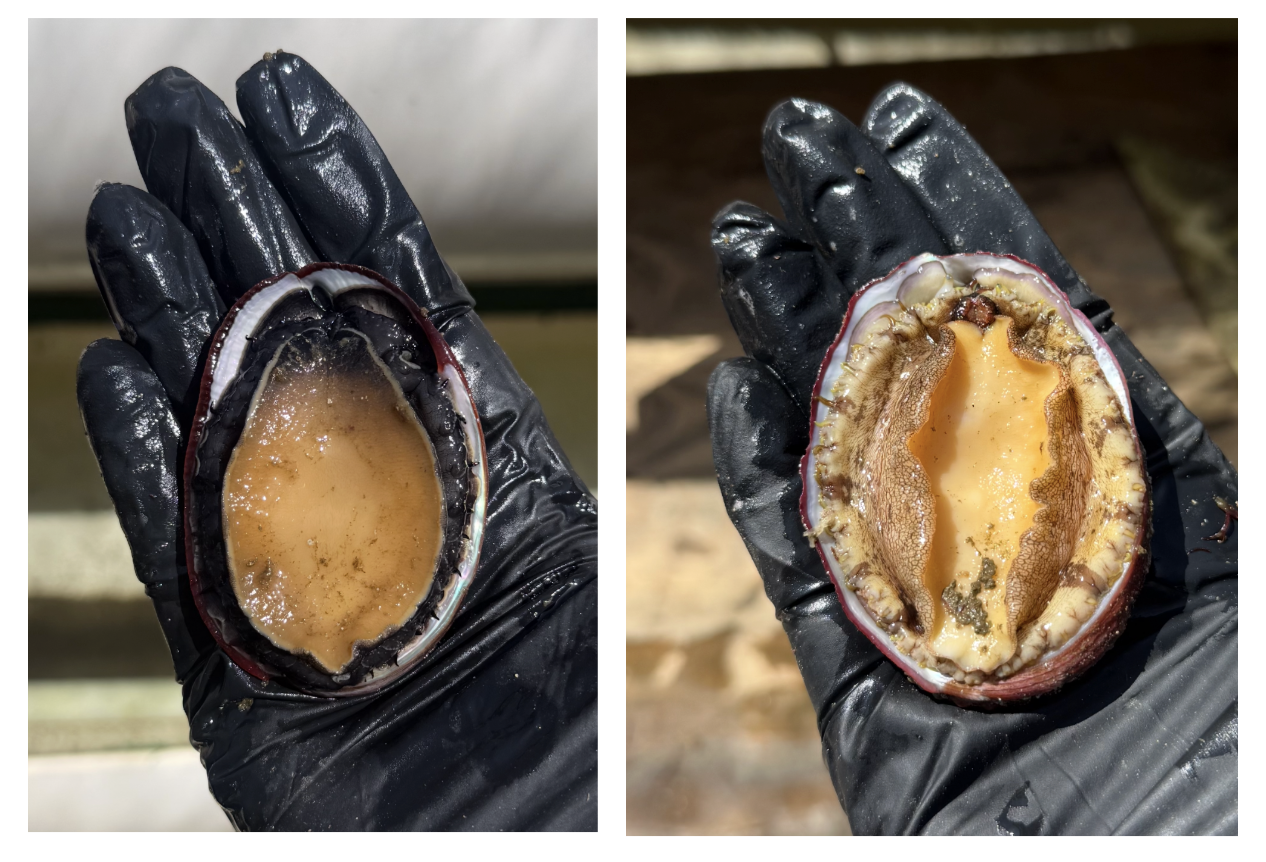
Pictured on the left side is a red abalone while pictured on the right is a white abalone. The red abalone, Haliotis rufescens, has a darker gray/black outer foot color. On the contrary, the white abalone, Haliotis sorenseni, has a light brownish pattern on the foot.
Hearing all this talk about abalone must make you at least a little bit curious about what it tastes like, right? Well it can be said that it is a mix of scallop and calamari with a slight salty taste. It can be prepared many different ways such as pan fried, steamed, mermaid style or raw. Although abalone fisheries are projected to stay closed until April 1, 2036, don’t worry you can try this rare California staple from, you guessed it, The Cultured Abalone Farm!
Let’s make abalone well known again, not just as the tasty dish they are, but also as how important they are in our oceans.
Meet the Author
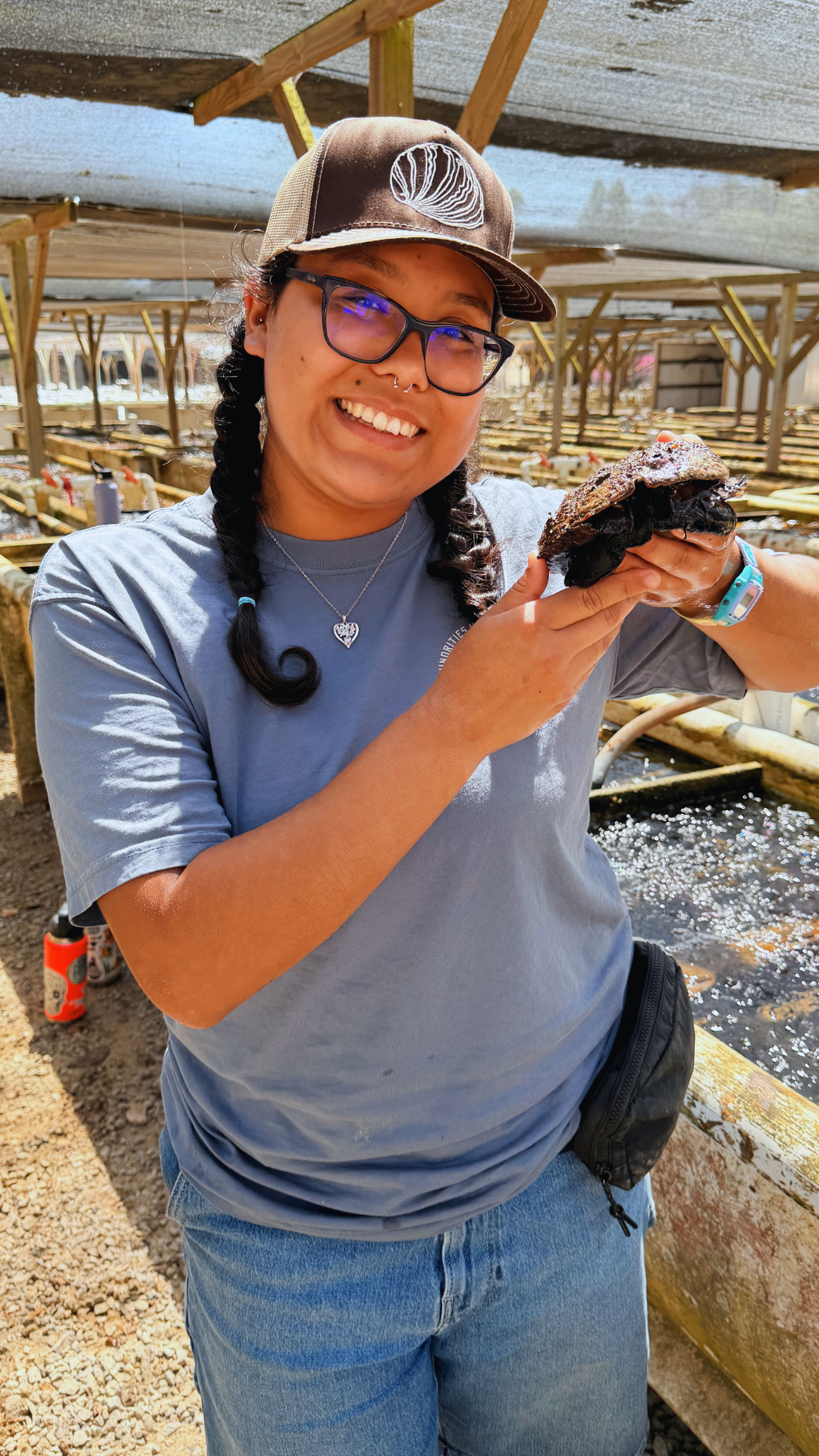
Araceli Hernandez
B.S. in Aquatic Biology from University of California, Santa Barbara and 2026 MIA Summer Intern
